Kippers, Dominoes and a Practice Chanter: Corby's Scottish Heart on an Ordinary Weeknight
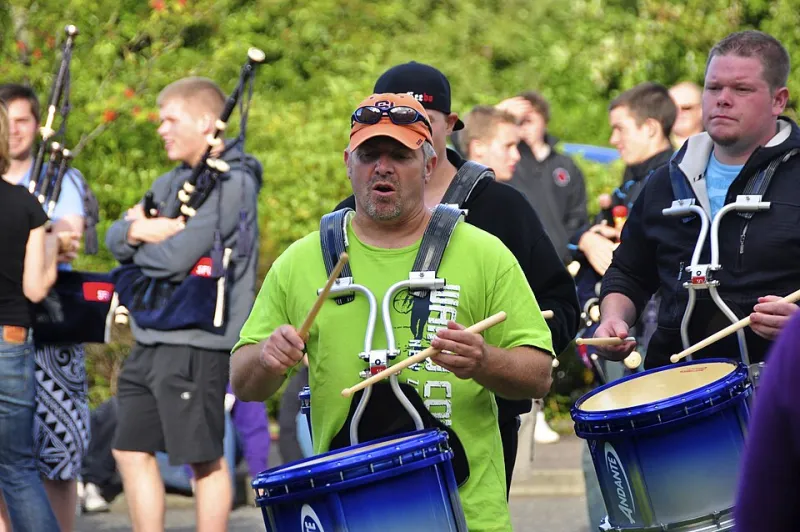
Photo: Simon Fraser University - University Communications, CC BY 2.0, via Wikimedia Commons
Every August, Corby puts on its kilt and the whole country notices. The Highland Gathering fills a field, the pipes echo off the warehouse units, and for a weekend the town's Scottish roots get the attention they deserve. Then the marquees come down, the bunting goes in a box, and everyone goes back to doing what Corby does best: getting on with it.
But that's the thing about heritage. The interesting bit isn't the festival. It's the Wednesday night, the Saturday morning, the Sunday lunchtime — the ordinary hours when nobody's watching and the tradition still quietly shows up.
So we went looking for it. Not the tartan and the souvenir stalls, but the seven places where Corby's Scottish soul actually lives in 2026.
1. The practice room where the chanters come out
Half seven on a Wednesday, and a community hall somewhere off the town centre is filling up with people carrying long plastic tubes. Practice chanters. The pipe band's learners' hour.
There's a fourteen-year-old working through her first tune, a man in his sixties who's been playing since he was a boy in Lanarkshire, and a retired steelworker who freely admits he's been "coming for three years and still can't get the gracenotes". Nobody minds. The whole point of the evening is that you're allowed to be rubbish in public.
What strikes you is the noise. Not the volume — the sound of a dozen chanters in a room is somewhere between a flock of geese and a badly tuned radio — but the fact that it's happening at all. Somebody has booked the hall, somebody else has brought the biscuits, and the band's next generation is being taught by the last one.
2. The bakery counter at half seven in the morning
If you want to understand a town's food history, go shopping before eight. Corby's family bakeries do a brisk trade in things you'd struggle to find in a supermarket: tattie scones, morning rolls with a proper floury top, white pudding, the occasional fruit slice.
"People come in for a roll and they want it the way their mum had it," one counter assistant told us, bagging a dozen rolls in under ten seconds. "We know the regulars' orders. Some of them don't even need to say anything."
The queue is a mix of accents — the flattened Corby vowels, the lingering Glasgow, and a fair few in between. Nobody comments on it. Nobody needs to.
3. The social club lounge on a Sunday
The Scottish clubs and social clubs around town are where the heritage stops being heritage and just becomes a normal afternoon. Dominoes in the corner. The football on a screen nobody's really watching. A bottle of something orange and sugary that you'd be hard-pressed to find in a Corby supermarket fridge.
What you hear is the best possible argument for a social club in 2026: people talking to each other who aren't related. A woman in her eighties explaining how her parents answered a recruitment advert in the 1950s and got on a train with two suitcases. A bloke in his twenties saying he only joined for the cheap pint and stayed for the company.
4. The butchers with the square sausage
There's a particular satisfaction in a butcher's window that has clearly been arranged by someone who has been doing it since the 1980s. Lorne sausage, sliced thick. Black pudding stacked like books. Steak pie with a lid you could build a shed on.
Corby's Scottish migration arrived mainly through the steelworks, and the families who came brought their shopping habits with them. Three or four decades on, the butchers still cut to that demand — and increasingly, the customers buying it have never lived north of the border. It's not nostalgia. It's just lunch.
5. The listening room at the library
The local history archive is where the accent is preserved properly. Recordings of families who came down from Motherwell, Bellshill and Glasgow to work at Stewarts & Lloyds, telling their own stories in their own voices.
It's the details that get you. The temperature of the water in the works. The first time they saw a council house with a bathroom. The phone call home on a Sunday and how much it cost. You can listen for twenty minutes and come out understanding why Corby looks the way it does far better than any plaque will tell you.
6. The empty field in February
Go back to the Gathering ground in winter. It's just a field — wet grass, a bit of drainage, a gate. But stand there and it's easy to picture the whole thing, and easy to understand that the one weekend a year doesn't come from nowhere. It comes from a town that's been keeping this alive in a hundred small ways, out of season, for sixty-odd years.
7. The touchline on a Saturday morning
Look at a team sheet for a youth game anywhere in town and you'll find a running list of Scottish surnames that Corby simply absorbed. Then listen to the parents shouting encouragement in an accent that is neither one thing nor the other and is completely its own.
"People say the accent's dying out," a grandparent in a fleece told us, wrapped around a coffee. "I don't think it's dying. I think it's just become Corby."
Which is probably the most accurate thing anyone said all week.
The point of it
Corby's Scottish story doesn't need a festival to prove it's real. It's in a practice chanter being played badly in a hired hall on a Wednesday, in a roll bagged up before eight, in the sheer stubbornness of a town that brought something with it in a suitcase and refused to put it down.
You don't have to be Scottish to look. You just have to go on a weeknight.