Nattering Is a Civic Sport: In Defence of Corby's Stranger Chat

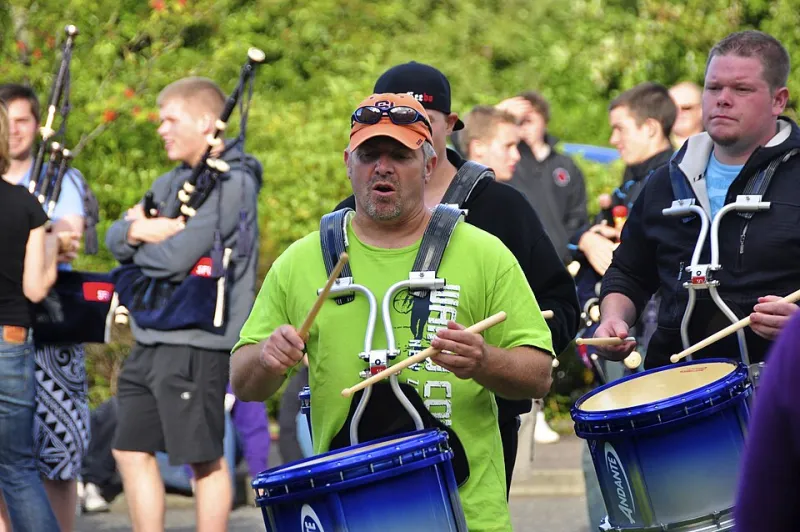
Photo: two strangers chatting on a UK town street, friendly conversation, overcast British weather, via i.imgflip.com
There is a particular kind of pause that happens at a Corby bus stop. A bus is late, the wind is doing that thing it does on Rockingham Road, and somebody in a fleece turns to you and says, with no preamble whatsoever, "They reckon it's every twenty minutes, but I've been here since half past."
Nothing follows. No agenda. You agree, or you don't, and then you both go back to staring at the road. It is, by any reasonable measure, a pointless exchange. It is also one of the small, load-bearing habits that holds this town together — and it's worth saying out loud before it quietly disappears.
The two-second economy
Economists like to talk about productivity. Corby runs on something less measurable: the willingness to acknowledge another human being before you've been formally introduced. It costs nothing. It never appears on a spreadsheet. And it does more for the feeling of a place than a decade of regeneration signage.
A lot of us moved here, or our parents did, or our grandparents were sent down with a suitcase and a job at the works. That inheritance — of people arriving somewhere strange and needing to be spoken to — is still in the water. The Scots who came down in the middle of the last century to build pipes and a life didn't bring much luggage, but they brought the assumption that a neighbour is someone you talk to, not someone you avoid eye contact with over a shared fence panel.
"My mum's from Glasgow originally, and she'll talk to a lamppost," says Jenna, who works behind a till in the town centre and has clearly inherited the trait. "But it's not just her generation. I get people asking me how my shift's going, and they mean it. You don't get that in a big city. You get looked at like you've grown a second head."
Where it actually happens
The Corby hello doesn't live in formal settings. There's no committee. It turns up in the queue at the chip shop on a Friday, when somebody behind you offers a firm opinion on the correct distribution of salt and vinegar. It turns up at the checkout when your basket is mostly biscuits and someone decides to comment on it. It turns up in the car park at West Glebe on a Sunday morning, where dog walkers operate a kind of informal intelligence service about which gate is muddy.
And it turns up in the small, unglamorous moments — the person who holds a door, the driver who waves you across even though they had right of way, the one who notices you're reading a map and asks if you're lost.
None of this is unique to Corby, obviously. Small towns across Northamptonshire do it. But there's a specific flavour here: it's chatty without being nosey, familiar without being fussy. Nobody's trying to sell you anything. They're just confirming you exist, and inviting you to confirm the same back.
The heads-down problem
Here's the uncomfortable bit. We are all, slowly, opting out. Headphones on before we've even left the house. A phone in the hand as a social shield. Self-checkouts that spare us the horror of a human interaction. Deliveries that mean we never have to stand in a queue and discover that the bloke in front supports the Steelmen and has strong views on the parking situation.
None of it is villainous. Sometimes you just want to get your shopping and go home. But convenience has a habit of quietly deleting the friction that used to make a neighbourhood feel like a neighbourhood. And once it's gone, it's surprisingly hard to put back.
"I've noticed it since the pandemic, if I'm honest," says Alan, a retired engineer who walks the length of the town most mornings. "People got out of the habit of chatting to anyone they didn't already know. You have to work at it now. But you say hello once and the next week they say it first. It's like a switch."
Protecting a small-town superpower
So what does defending it actually look like? Not much, and that's the point. It looks like taking one earphone out at the bus stop. It looks like saying "morning" to the person waiting with you at the counter, and not dying of embarrassment if they don't reply. It looks like letting the older gentleman in the queue tell you about the state of the town in 1978, because he's going to tell you anyway and honestly it's more interesting than your phone.
It looks, above all, like not being too cool for it.
The cynics will say it's just small talk, and that small talk is filler. But filler is what mortar is — dull on its own, and the only reason a wall stands up. A town is not its buildings or its roundabouts or its shopping centre. It's whether the person next to you is a stranger or a person you've said hello to.
Corby, for all its changing skyline, has so far resisted the national drift into silent, eyes-front living. That's not a small thing. It might even be the best thing we've got.
So: hello. How's your day going? Beautiful morning for it, even if the bus is late.