You’re on Air, Corby: A Shift With the Volunteers Who Keep the Town Talking
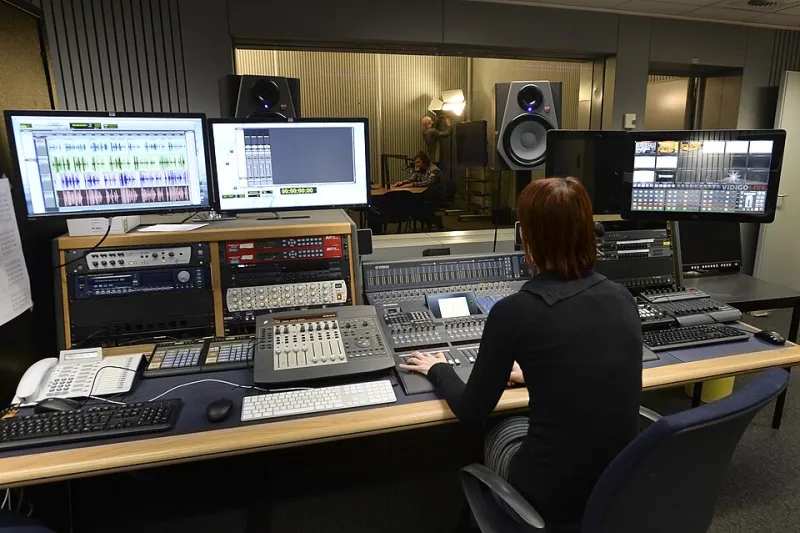
Photo: Europäische Kommission - Audiovisueller Dienst, Etienne Ansotte, CE - Service audiovisuel, EC - Audiovisual Service, Shimera, CC BY 4.0, via Wikimedia Commons
At 7.58am on a grey November Tuesday, the lights above the studio door flick from red to green. Inside, a presenter is adjusting a headset, a producer is scribbling the last of the morning’s notes, and someone in the corner is quietly rehearsing a birthday dedication. Outside, Corby is doing what Corby does: buses sighing along, shop shutters rolling up, kettles clicking on in kitchens across the town. Inside, the microphone opens.
“Good morning, Corby. You’re on air.”
It is a small sentence with a big job. For the next few hours, this room will become part noticeboard, part neighbour, part jukebox and part lifeboat for anyone who has the radio on while they get ready, drive to work or sit with a second cup of tea.
The morning shift begins before the coffee
People often imagine community radio as a bloke in a shed with a dusty record collection. The reality is warmer, messier and much more organised. There is a rota. There is a running order. There is a folder of council notices, charity appeals and local events that need reading out between songs. There is also a laptop that has been coaxed back to life more times than anyone can count.
The breakfast presenter is a volunteer, as is the producer, as is the person who answers the phone when a listener rings in to request something for a neighbour who has had a rough week. Nobody here is chasing a national audience. They are chasing the right audience: the person on Kettering Road, the parent doing the school run, the night-shift worker winding down, the older resident who likes a familiar voice with their toast.
That is the quiet magic of it. A streaming playlist knows what you listened to last week. It does not know that it is Mrs Patel’s 80th birthday, that the under-11s football team won at the weekend, or that the church hall is short of volunteers for the Christmas lunch. Community radio knows because people tell it.
Dedications, dog walkers and the local noticeboard
By 8.30am, the request line is warming up. A man rings to ask for a song for his wife, who is recovering after a fall. Someone else wants a shout-out for a granddaughter starting a new job in town. A regular caller asks whether the station can mention a missing cat — not a lost cause, just a ginger one last seen near the shops — and the producer adds it to the list with the seriousness of a news editor.
This is not filler. It is the glue.
Between the records, the presenter reads out what is happening locally: a coffee morning, a repair café, a choir looking for new voices, a warning about roadworks. The information is useful, but the tone matters just as much. It is not read like a public announcement. It is read like a neighbour leaning over the fence.
And then there is the music. The station does not pretend to compete with the big streaming platforms, and it does not need to. One show might be heavy on 1980s pop, the next on folk, the next on soul and reggae. There are specialist programmes made by people who really know their stuff, and there are shows where the presenter simply plays what feels right for a wet Wednesday. Both work. Both sound like Corby.
The school visit hour
Mid-morning, the studio gets busier. A group of primary school children arrives for a visit, wide-eyed and slightly overawed by the foam-covered walls and the tangle of cables. They are shown the desk, the headphones and the button that plays the jingles. One child is invited to read the weather. Another gets to press the button for the station ident, which she does with the concentration of an astronaut launching a rocket.
This is the bit that does not translate to an algorithm. The children will remember standing in front of a microphone in their own town. Their parents will hear about it for weeks. A few of them might come back in ten years and volunteer.
Community radio is often described as a training ground, and it is. Presenters learn to interview, producers learn to edit, request-takers learn to listen. But it is also a front room. It is a place where people can try something new without being laughed at, and where a wobbly first broadcast is treated as a rite of passage rather than a failure.
Why it still matters in a streaming age
It would be easy to assume that community radio is a lovely relic, kept alive by nostalgia and a stubborn dislike of change. That misses the point. In a streaming age, local radio offers something the platforms cannot: presence. It is happening now, in this town, with these people. It can respond to the weather outside the window, the road closure at the end of the street, the fundraiser that needs a push before the weekend.
It also offers company. Not the polished, performative company of a national breakfast show, but the slightly chaotic company of people who live around the corner. When a presenter reads out a listener’s message and laughs at their own joke, that is not a flaw. It is the reason people tune in.
By midday, the breakfast team is handing over to the next volunteer. Mugs are rinsed, notes are passed on, and the red light goes off for a moment. The studio will fill again in the afternoon. Someone else will open the microphone, read the community notices, play a request for a neighbour and remind Corby that it is a town full of people worth listening to.
You can find the station on the dial, online and in the middle of the town’s daily routine. But really, it is found in the small things: a dedication, a mention, a familiar voice saying good morning. In a world of endless playlists, that still sounds like something worth tuning in for.